Showing posts with label landscape design. Show all posts

Friday, July 15, 2011

It's Come a Long Way...

 Most sources say that a landscape can be considered mature when it is around three years old. I don't agree with that. Six years is probably more accurate, which is now the age of my landscape. At three years, my trees and shrubs were far from the mature sizes listed in garden planning literature. Now, they are about the size expected at maturity. This photo shows what I started with when we moved to this property.


This is what part of my back yard looks like now. Over the years we've lost quite a few trees to the elements, various perennials to age, prickly pear cactus to cochineal scale, other plants to drought, others to rot--just what you would expect over the life of a garden.


 As the landscape matured, I replaced fewer and fewer plants. When everything was new, I needed numerous plants to make it look less barren, but as the landscape matured, there was little need to replace. When I talk about a mature garden, I do exclude cacti and Agave species, which will continue to grow for decades.


What do I wish I would have done six years ago if I could do it over again? Rather than my heavy emphasis on zeriscape with all the Mesquite and Palo Verde trees, I would have planted a 'Wonderful' pomegranate, a few 'Arizona Sweet' orange trees and a couple of 'Desert Gold' or 'Earli Grande' peach trees, a Mission Fig rather than the Brown Turkey Fig I have that has not done all that well. In addition, had I planted fruit trees, I would have put in a separate irrigation valve dedicated to the fruit trees, and there would have been a raised, enclosed vegetable garden with retractable sun shade, and a separate vegetable garden irrigation valve.

But, we don't get do-overs, so as long as we live here, my garden is what it is, and that's the way it's going to stay. I'll just buy my fruit and vegetables at the grocery store.


Thursday, December 16, 2010

Tricky Transformation


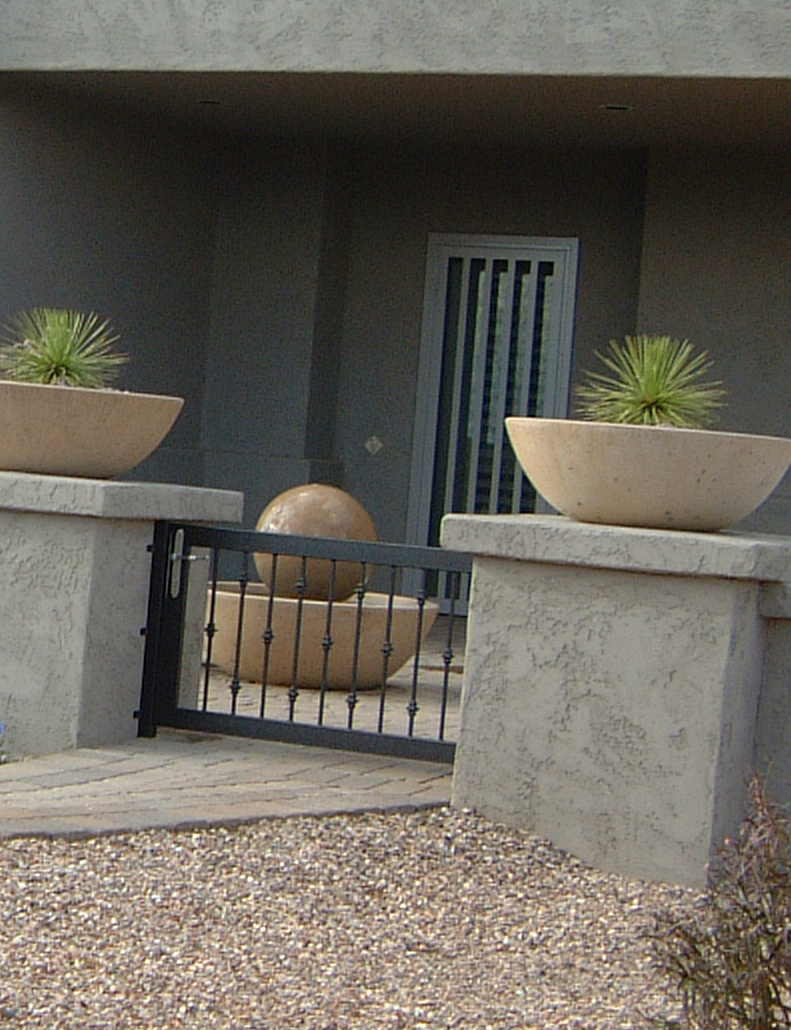
The sound of trickling water here in the desert makes it seem cooler somehow, so a fountain in my front courtyard was a top priority when I designed my landscape back in 2005. I didn't want one of the typical Mediterranean styles that are the most common around here because my house is more Southwest Contemporary in style. So, I chose a wok and ball style fountain that basically just delivered water up the center of the ball and bubbled up just enough to wet the ball. The photo, taken soon after installation, is not the best, but you can get the general idea.


All was well for several years, but eventually the pump seemed to lose its steam, so we sought to replace it. What a farce that turned out to be. In order to replace the pump, the large concrete ball had to come off its pedestal, the pump replaced and the electrical cord rethreaded through a special opening. The first repair company was unable to move the 800 pound ball, even with four helpers. The second repair company brought a small army and removed the ball, but they were then unable to figure out how to remove the pump's electrical cord. The third company brought a new pump, put it in place, but then couldn't figure out how to rethread the electrical connection. They said they would be back as soon as they figured it out, but they never returned. I guess they never did figure out how to do it. So, the whole thing sat in four pieces for several months while we tried to find a company that could handle the job properly. By then, we had put so much money into the various attempts at repair plus the cost of the new pump, that hiring yet another company seemed kind of stupid, so we just decided we didn't need a fountain. I had our landscape maintenance crew roll the 800 pound concrete ball to our back yard, and we converted the fountain into a planter with a kinetic wind sculpture in the center.


The ball now sits in my backyard, as yard art. It also makes a seat of sorts, except in summer! If I ever get enough ambition, I may Mosaic the whole thing.


The whole ordeal of changing over the fountain was so frustrating that I procrastinated in purchaing potting soil and plants. Today I finally got around to getting some seasonal bedding plants and soon I'll have some flowers, fragrance and movement in my courtyard. However, I've just added to my garden chores because I have one more thing to hand water! Come summer, I'll probably fill the thing with rocks and just let the wind do the work.

Sunday, July 12, 2009

Half-Way to Fall


Even in the depths of summer, I do have some greenery, but nothing much flowering. It's just too hot! This weekend I got rid of the last of my container vegetable garden, as well as all the struggling potted geraniums, creeping charlie, dwarf marigolds and half dead cacti. This year I've upped my irrigation schedule to every three days for the shrubs and groundcover. Last year, I followed the guidelines for this area, which called for every 7-21 days. I tried the shortest--7 days--and my plants just about fried. I have a desert adapted landscape for the most part, so I'm a bit surprised that I have to water so often to keep the plants from suffering from water stress. However, I don't feel too bad about the more frequent watering as we are behind on annual rainfall. I've had only 1.96 inches since January 1st--quite short of the expected amount by this time.

The suggested tree watering schedule works fine at once a month or every 5 weeks. The only exception is my Tipu Tree, which is still getting established. I water it every two weeks.


With temperatures in the 115 degree range, the leaves of the Mexican Bird of Paradise shrub fold inward to conserve moisture and reduce sun exposure. From a distance, the shrub appears to be wilted, but this is normal for these extreme summer days.


Tiger Whiptail (Aspidoscelis tigris)

This lizard has the longest tail I've ever seen! There is not enough contrast to really get the full effect, but its tail is about twice the length of its body. This one must have been an artful dodger all season to have avoided the roaming neighbor cat.


When walking around my garden, I noticed a couple of empty bird egg shells on the ground under a mesquite tree. When I looked up, I spotted this dove for the first time. I'm not sure if the eggs are from hatched babies, or just casualties of the wind. After seeing so many poorly constructed dove nests, this one appears to be a better built model.

Saturday, June 6, 2009

June Desert Garden


This is as green as my desert garden gets. The flowers are gone for the season except for a few cactus flowers, the Red Bird of Paradise and Orange Bells shrubs, and the Texas Sage in this photo. It bloomed because we had a light rain about 10 days ago. No one is quite sure of the process this plant uses to produce this barometer effect. The desert trees are at their best as far as foliage. Notice that the kinetic wind sculpture is completely still. This is a rare occurrence.


I was right! The flowers on this early-blooming Barrel Cactus were especially large this year. Both buds and flowers on this cactus are beautiful, but I have several other Barrels that will bloom in August, and they have orange flowers that I like more.


Container vegetable gardening is fun! This sweet pepper plant has 21 peppers on it right now. They're supposed to be red, so I guess I need to wait awhile. Since this is my first attempt at something other than tomatoes, I'm not sure if they turn red on the plant or after they're picked. Maybe I'll pick a few and find out. Looks like we are in for a lot of pepper dishes.


I've harvested about two dozen pattypan squash and a dozen cannonball zucchini so far from my two squash vines. I never tire of eating steamed squash with a bit of butter, salt and pepper, however, I do prepare stuffed squash, and a New Mexico favorite, Calabacitos Con Queso on a regular basis. I don't enjoy cooking--never have--but I refuse to let these veggies go to waste after all my work!

Saturday, April 25, 2009

Golden April Carpet

A golden carpet of Palo Verde tree flowers.

Although these dropped flowers make quite a mess and actually completely cover many small cacti, I really enjoy seeing this golden carpet. I'll worry about the mess later.

Tuesday, April 7, 2009

Blooms, Butterflies and Bottles

Echinopsis candicans

I was able to catch the opening blooms of this Argentine Giant for a change. If the temperature is below about 80 degrees, the buds will open during the day instead of at night. The flowers do wilt within a few hours, though. If the flowers open at night, they will last about 12 hours this time of year.


Arizona Bottle Tree (Not a Plant!)

I've been admiring Pam's (Digging) Texas bottle tree for months and since my birthday was coming up, I told my husband I wanted a bottle tree for my gift, but one with an Arizona flair that would fit in with my desert landscape. He designed this rebar and steel tree for me, and I love it! I got the dozen blue wine bottles from Ebay. It stands about nine feet tall, and really glows in early morning and late afternoon.


Rosa 'Peace'

When I've shown this rose variety before, many folks have commented that it looks different that the 'Peace' rose they have. Most comment theirs has more pink. There are several different varieties of 'Peace', and the one with more pink is probably 'Chicago Peace'.


One view of my late spring, April desert garden, looking east. The Palo Verde trees are blooming lightly, and the Mesquites are just now putting out their new leaves, so they are kind of bare. They are not really deciduous, but do shed old leaves each spring.

Painted Lady (Vanessa cardui)

A Painted Lady butterfly rests on my just-sprouting radishes. (I really put these in too late, so I'm not sure I'll get radishes.) This butterfly is found worldwide, and it is an irruptive migrant, that is, it migrates without regard to geography or season. It lives about two weeks. My garden is full of them this week, but I see them all year.


Thelocactus bicolor


I need to get this cactus in the ground! Each time I get the time, it puts out another round of gorgeous flowers, so I put it off. Not that I wish it wouldn't bloom, I would just like to transplant it while the weather is tolerable. I think the flowers on this genus are especially beautiful.

Tuesday, March 17, 2009

Lots Going On


My garden looks good right now, and will continue to produce cactus flowers, blooming shrubs and ground coverings until about May, depending how high the temperatures get. The Mesquite and Palo Verde trees are not very attractive right now as they are shedding last year's leaves and in preparation for new leaves, flowers and catkins. Around May 1, the Palo Verdes are in full bloom. It's always a spectacular show, but sometimes hazardous for the tree if the branches get too heavy with blooms. This sometimes causes the branches to split if the tree was heavily watered to produce fast growth. Weak wood is the result.


I love the way the papery bracts of the Bougainvillea appear translucent against the blue sky and bright sunlight. This is the cultivar, B. "Barbara Karst".


A field of Parry's Penstemon. The stems on this stand are quite tall, about 40 inches high. If it is too breezy, many of these long stalks will break or bend. It's been calm, so as of today, they are all upright.

Hardenbergia violacea


This Lilac Vine is a new addition to my garden. My nurseryman said it will do well even in summer, but everything I've read says it's a shade plant for summers in Phoenix. Time will tell. Since the nursery guarantees all plants for a year, I'm willing to take the chance. I hope it makes it--I think the flowers, which appear only at this time of year, are quite pretty. The dark green leaves are also attractive.


-------------------------------------------------


Look how much this Agave stalk has grown in just one week. Scroll down to last Tuesday's post to see the difference! Although I've seen the unbelievably rapid growth of Agave stalks, I continue to be fascinated by the whole process. It's no wonder the Agave dies after producing this stalk. It takes tremendous energy resources to produce something this big this fast. The stalk is over three inches in diameter now and ten feet tall! It is now forming flower buds.


Notice the long flower coverings with sharp points. This is protect the buds as they are emerging. These eventually wilt and dry, exposing the flowers to pollinators like Hawk-moths, hummingbirds, wasps, bees, and butterflies. Bats prefer the branched inflorescence of other Agave species.

Tuesday, March 10, 2009

A Garden Surprise


The Bush Morning Glories (Convolvulus cneorum) are now in full bloom. I've lost quite a few of these perennials in the last couple of years, but the ones left are now quite large and present a spectacular display of flowers for a three week period in March.

My Garden Monk looks like he has picked one of the Bush Morning Glory flowers, but actually the stem has grown in the space between his hands and robe.


There are only a few California Poppies (Eschscholzia californica) blooming in my landscape this year. One of the reasons is that we are near the common area along a roadway, and the landscape crews came through on a breezy day and sprayed their pre-emergent and weed killer combo along the roadway, and the stuff drifted into my yard. Wildflowers are very sensitive to both chemicals, so I've found many dead ones in my front yard.

We won't have a profuse display of wildflowers in the desert this year because of the rain pattern for the months between September and January. A certain amount of rain is necessary to assure a massive display. We had one last year, and it's rare to have several in a row, so I'm not surprised. Even my Desert Bluebells, which are normally prolific, have left a lot to be desired.


This was a surprise! I swear that it wasn't there on Saturday, and when I strolled through my garden on Monday, there it was! This Agave lophantha stalk will grow rapidly and then put out some type of inflorescence.


Agave plants have three types of flower stalks depending on species. One type is the raceme, or an inflorescence having stalked flowers arranged singly along an elongated unbranched axis. Another is a spikate inflorescence where the flowers cling to the stalk in pairs or clusters. The third, is a paniculate inflorescence where the flowers appear in clusters on lateral branches, like a candelabra. This is definitely not a paniculate type, so it will be interesting to see what emerges as it grows.


The Agave will die after the flower stalk is mature. Usually Agave pups emerge to replace the dead plant. I don't see any pups, so this might end up being a bare spot in my garden.

This is a close up of the Agave flower stalk. In the close up, it looks like the inflorescence type may be a raceme. It's really hard to know as Agave species easily cross pollinate.


I thought this Blackfoot Daisy (Melampodium leucanthum) was gone for good when it dried up this past summer, but it has come back larger than ever. I wish it would drop some seeds and spread!

Sunday, January 18, 2009

Shades of Green


Although these plants are not as close together as they appear in this photo, I thought the various shades of green, as well as the contrasting textures, made this an interesting photo.

A lizard is sunning itself on the boulder. It kind of blends in with the rock. I didn't even notice it when I snapped the photo.

Rosa 'Gold Glow'

This is my latest hybrid tea rose, planted in late September. It currently has seven open roses and four buds. I expected the color to be a deeper gold-yellow, but since all my other roses have various shades and hues depending on conditions, I suppose this one will be the same.

Since this rose was still blooming, I didn't prune it. All my others are thinned and pruned, and tiny leaf buds have already begun on the pruned canes. By mid-March I should have more roses to show.


Tuesday, January 13, 2009

Early Signs of Spring


One of the first signs of impending spring (technically it's still considered late winter here) is the appearance of flowers on the Brittle Bush (Encelia farinosa). These are the first flowers on one of the younger volunteer plants that popped up in my garden in the past year.

In the foreground is a Yellow Emu Bush (Eremophila maculata 'Aurea') that is covered with yellow flowers. The tall bush is Tecoma Stans 'Orange Jubilee', which is surprisingly bereft of flowers. It is over 10 feet tall, so it looks more like a small multi-trunked tree. As long as we haven't had temperatures below 32°F, foliage remains and there are flowers. This bush has just a few small flowers right now, but as the weather warms, they will become plentiful.

Ferocactus cylindraceus flowers bloom in July-August and then form seed pods that dry over the course of months. In the wild, the pods will dislodge as they dry and become loose, spilling seeds on the desert floor. These are not dry as they can't be pulled from the cactus yet. Sometimes it takes six to nine months before they can be removed. At this stage, I think they are quite decorative.


Early flowers on Red Yucca (Hesperaloe parviflora) stalk, which also contains a still-green seed pod from an earlier flower. The stalks usually appear in spring and fall. This one is early, and the only one among the several Red Yuccas I have in my garden.


This tiny young hummingbird rests on the branch of a budding Chinese Elm tree. The hummer (probably Anna's Hummingbird, but when young it's more difficult to identify them for sure) had been feeding on the few open flowers on the Red Yucca shown above.


Good old reliable Desert Marigold plants decided to grow all in a row along the edge of the patio. The seeds probably washed off the patio and planted themselves here last summer. I can always count on this wildflower to add spots of color throughout my garden all year. These wildflowers can last up to a year if the conditions are right. It's fun to see where new plants pop up. They seem to situate themselves in places where they complement the surrounding plants.

Sunday, November 23, 2008

Arizona Garden Trivia


While doing some hand watering around my garden today, I was surprised to see this Rain Lilly (Zephyranthes candida) peeking out from under an overgrown Rosemary (Rosmarinus officinalis) shrub. I had totally forgotten about it since the Rain Lillies dry up and disappear in summer and late winter. Rather than trim the Rosemary, which has a pleasing shape just as it is, I think I'll just dig up the Rain Lilly bulbs after the plant dries up and relocate them to another area where they will be more visible. If I remember where they are located!


Something else peeking out from under a shrub is my concrete raccoon that had been covered by a Bush Morning Glory until I trimmed it back some for winter. He's about 12 years old now and a little weatherbeaten, but I think he's still realistic looking even though I've never seen a real raccoon. They are not uncommon in Arizona, but they usually hang out near perennial streams, lakes, and reservoirs and not in residential areas. I always thought they were cute in photos, hence the yard art.


My Chuparosa (Justicia californica) is growing like crazy in our mild fall weather. Both people and plants love this time of year in the desert. Chuparosa can get very leggy and should be trimmed to shape, but I haven't done that yet as it has a lot of room to spread out and I didn't think it needed it. Now, it is looking a bit unkempt, so next week I'll get out the pruning tools again.


Today I added another sun catcher to my plant stand/wind chime/sun catcher holder. I have no other place to hang all these things, so for years I've just used this plant stand. It stands near a glider on the patio and makes pleasant sounds with the slightest breeze. When it's really windy, it becomes a cacophony of clanging and banging.

``````````````````````````````````


Now, some real Arizona desert trivia from outside my garden.

All cacti are succulents, but not all succulents are cacti.

The Sonoran Desert where I live is the largest desert in North America and is possibly one of the most irrigated deserts. The entire Phoenix area was reclaimed from the desert by modern methods of water control.

Javelina, a Peccary, can become a pest in Arizona landscapes located near open desert areas. They have tough mouths and love succulent plants, and a herd can wreak havoc on a desert garden in no time. Prickly pear cactus is one of their favorite foods. Spines and glochids don't bother them a bit. Although somewhat pig-like in appearance, they are actually more closely related to antelope.

Tuesday, October 28, 2008

Blooming Today In My Garden...

Chuparosa (Justicia californica)
Mexican Bird of Paradise (Caesalpinia mexicana)
Lantana 'New Gold"
Desert Marigold (Baileya multiradiata) and Lady Slipper(Pedilanthus macrocarpus)


In May, I posted the views from my house looking north and south. This is the rest of the story.
Looking west down my street. Today was kind of hazy, as you can see in this and the next photo. Almost every house has desert landscaping. The staked Mesquite is on my property, which ends at the curbing.


When I look east, this is my view right across the road. The crops change with the season. Currently growing is Maize. You can see the University of Phoenix Stadium and the Phoenix Mountains beyond.