Showing posts with label shrub. Show all posts

Saturday, July 10, 2010

Desert Senna

Cassia covesii or Senna covesii

This bushy perennial reproduces by seeds only, and it produces plenty of those on dried pods that I've collected over the last two years. This is a small plant and often comes in wildflower mixes, but I've never seen it for sale at a nursery, probably because it is so common. Actually, this Desert Senna plant is the only thing that came up from a package of summer wildflower seeds I broadcasted two summers ago. The stems are one to two feet high, branching from a woody base, and it flowers from March to October. Some folks find it unattractive when it is not in flower, but I don't it mind at all. It just looks good sitting there greening up a small section of my side yard.  I want more of them.


The Desert Senna is an important food source to caterpillars, which helps in the spread of native butterflies. However, I've not seen any caterpillars hanging around this lone plant, ever. In general I don't see a lot of butterflies in my landscape although I have many plants that supposedly attract butterflies, but to date, butterflies have been sparse.


Desert senna is a very common native plant of dry disturbed soil throughout Arizona, which is found along roadsides and waste places, or so they say. I really don't see a lot of it along roadsides in the areas where I travel. It also grows on rocky slopes, mesas, sandy river bottoms, washes in the deserts, and desert grassland ranges. Again, I've not seen any when I've gone into these areas.

I have hundreds of seeds from this plant that I've scattered throughout my garden, and so far, not a one has come up. If the plant is so common here in the desert, one would think I'd have a yard full by now!

Thursday, June 10, 2010

Something Different, Knifeleaf Acacia

Acacia cultriformis


Acacia cultriformis, commonly called Knifeleaf Acacia, is a shrub that I added to my landscape last year. I thought it was unusual looking, and since I was looking for a small multi-trunk tree for an area that gets too much morning sun, it was a nice change from the more commonly chosen Caesalpinia mexicana (Mexican Bird of Paradise.) This Acacia will eventually grow to about 15 feet high and wide. The tough leaves are triangular and are located on the branches. As with most Acacias, it will have little yellow puff-ball flower clusters in spring. Acacia flowers have a wonderful fragrance reminiscent of honey. I located it so that it will eventually shade my large dining room window as well as provide that fragrance when the windows are open in spring.


This plant is good in USDA Zones 9-12 and requires little water once established. It loves full sun, but will take light shade. Interestingly, I've never seen any of these during the many garden tours I've attended, nor have I noticed them used in public areas. I asked the nurseryman at the place I purchased it if this was an indication that there was some problem with it, even though it matches well to our climate and conditions. He said that this shrub is not yet well known here, but he predicts that as locals see these as they grow into small trees they will become more popular, especially with folks who have smaller yards needing small desert-adapted trees.  


I'm hoping it doesn't have the negative that many other Acacias have--numerous volunteer plants from easily sprouted dropped seeds. Only time will tell!

Wednesday, May 26, 2010

May Miscellany


My Vitex agnus-castus or Chaste Tree (a shrub at this point) really grew a lot this spring. It has been languishing in my landscape for the past four years, which didn't bother me because I want to keep it as a shrub because of its location. The heavy rains earlier this year probably caused this sudden growth spurt, so I'm thinking of changing the irrigation emitter to a larger Gallons Per Hour (GPH) size to help it along.


Agave ocahui var. ocahui

I acquired this Agave ocahui last spring and it's turning out to be one of my favorite Agaves. I like the color and shape of it, and the fact that it is solitary, so I won't have to worry about offshoots popping up all over. Many of my Agave species freely produce offshoots--especially Agave angustifolia, which I can't even give away. Even the Agave huachucensis (Fort Huachuca Agave) is putting out plenty of offshoots for the first time this year, as well as my one Desert Agave (Agave deserti).


We've had some strong breezes this past week, which knocked off most of the Desert Museum Palo Verde blossoms. I'm glad that most of them came down at once so I can get the "Blow and Go" guys over here to clean up all the spring debris. I've pulled up most all of the dried wildflowers, and hundreds of the overly abundant Desert Marigold and Brittlebush plants that overtook my garden this year. Our weather has been unusually mild, so I'm glad I got most everything done before our first 100 degree day.

Tuesday, March 9, 2010

Spring Sprung When I Wasn't Looking

Feathery Cassia                         Desert Bluebells


While I was otherwise occupied, spring sprung at my house. We've had record rain this year--as of today, 7.68 inches! We had no frost at all this past winter, which allowed many plants to begin an extra early spring growth spurt. One would think with all the rain, I would have a yard full of wildflowers, but that's not the case. Since we had hardly any rain in the last quarter of 2009, the wildflowers didn't sprout until late January, so it will become too hot for most of them to make it.

However, the unusual weather really helped the weeds! I've been picking weeds for weeks but I can't keep up. Now that we received another inch of rain, I'll be back where I started. The Mediterranean Grass (Schismus barbatus) will burn off by May, so I don't worry about that except where it's really thick. My main concentration is on the Cheese Weeds (Malva parviflora) because their super long tap root makes them impossible to pull out as they get larger, London Rocket (Sisymbrium irio),  Sowthistle (Sonchus oleraceus) and Tumbleweed (Salsola kali var. tenuifolia).  My last resort will be Roundup Herbicide. I hate using it, but sometimes there is no choice. I could opt for pre-emergent in early winter to keep the weeds at bay, but that guarantees I'll have no wildflowers in spring, so I usually avoid it.


Chuparosa--a hummingbird favorite. It looks like a big tangle of stems with red flowers.


Eremophila hygrophana is an unusual Emu that I got a couple of years ago. It is a straggly looking thing, but I like the look.


Desert Marigold is springing up all over my yard. I let them do what they want--unless they are too close to sidewalks or drives. They bloom year-round and add color to an otherwise barren looking summer garden.


Penstemon parryi


Thousands of sprouting Penstemon plants are taking over one side of my yard. The heavy rain caused a bumper crop, but I have only five mature enough to bloom. Of all those Penstemon plants coming up, perhaps a few dozen will grow to maturity. It's too late for them to bloom this year,  but they make it through next spring, I'll have a nice field of Penstemon swaying in the breeze. Last year I had dozens of various Penstemon varieties in my garden. This year, only the Parry's Penstemon came up.

Valentine Emu


This Emu has been in bloom since February but right now it's in its full glory. I should have sheared this bush several years ago when it was small, but didn't, so it has grown lopsided and droopy. This is one bush that does a lot better when kept sheared and shaped.

My yard looks so barren now with the loss of so many trees to storms this past year. I will not replace them. There comes a point that it makes no sense to keep spending money on things I won't see to maturity. It's getting harder and harder for us to take care of our large property, but like so many others in this state, we are stuck because the real estate market is so bad that sales are practically non-existent. Never mind the money lost as values went down 50 percent over the past few years. We've resigned ourselves that we will never see that money again. So, no more money will be going into my house and garden! I'll live with the bare spots.

Monday, January 4, 2010

Pruning Time


This is a great time of year for roses in our Arizona desert, but it's also pruning time. As much as I hate to do it, I'm going to have to cut them back and strip the leaves in preparation for spring. We have not yet had any frost, so the roses have really had prolific blooms lately.  'Lady Elsie May', a repeat blooming shrub rose is my latest rose bush. It is the only one that I won't be doing any heavy pruning on, but it's still going to get a good haircut! I'm taking a chance on this rose--I'm not sure if it will do well in our summer heat.


Rosa 'Queen Elizabeth' 


Rosa 'Peace'


Rosa 'Hello Dolly'


Rosa 'Gold Glow


Rosa 'Red Intrepid'


Rosa 'Tiffany'


We have already pruned back all the Red Birds of Paradise and the Lantana shrubs will soon be cut back to the ground. Both will come back around March 1-15. This year we didn't get to cutting back the Purple Fountain Grass. Last year, the grass had a hard time coming back after pruning. These shrubs are now very dense and they actually need to be thinned drastically. I've tried that last year, but all I got this past summer was a dead middle and some puny plumes on the outside perimeter of the plants.


I'm also very disappointed in the Texas Sage shrubs. They really look bad--to the point I'm considering just taking them all out. I don't know what went wrong this year; perhaps the fact that we ended the year with less than half the expected average rainfall for the region. I did give all the landscape shrubs supplemental water in the heat of summer, but maybe not enough. Even with the cooler weather, they just look dry and sparse and just plain ugly. With my landscape maturing and filling in, I could do without these anyway.

Tuesday, May 19, 2009

Mixed Bag

Caesalpinia pulcherrima


My Red Bird of Paradise bushes have finally started to bloom. I've been seeing them all over town, lush and full of flowers, but my shrubs don't look so hot this year. The foliage is sparse, and although all the bushes have some flowers, they just don't look right. It's my own fault because I did not prune them back last fall. You can prune these shrubs down to the base each year and they will come back looking great.

Gasteria bicolor (Lawyer's Tongue)


I just love this tiny clay pot. It's 2-3/4 inches high and 4 inches in diameter. I bought it last year at a cactus show and sale, and it was already planted with a tiny Lawyer's Tongue offset. The offset has grown to the point I need to repot, but I'm wondering how I'm going to get it out of this pot without damaging the pot or the offset. The pot maker sold out of these popular little pots by mid morning.


Parodia horstii


I showed this same cactus in last week's post, but because it has been so prolific, I took another photo again today. These flowers are the latest of 12 so far. It's supposed to be a repeat bloomer with intermittent flowers over the summer. If so, it's going to be on my list of favorites!
Gymnocalycium saglionis


The second year for blooms on this Giant Chin cactus. I had it for years before it ever flowered, and the blooms have always been sparse. This year it has about 12 buds--a record for this specimen. The flowers are not as attractive as many other Gymnocalycium species. Most collectors have it for its form rather than the flower.
Ruellia brittoniana


One of the hosts at a garden tour stop gave me a cutting of Desert Petunia about four years ago. I can always count on it for a few spots of color. This is another plant that can be cut back to the base in the late fall, and it will come back almost immediately, looking fresh and full. It provides flowers off and on all year except in December and January.


-------------------------------


We've had thirteen consecutive days of temperatures over 100 degrees since May 1st, which is a record. Today was 108 degrees. This does not mean it will be hotter than normal the rest of the summer, but normal is not pleasant!


Tuesday, April 21, 2009

A 'No Cactus' Post

Zucchini

Until this year, my only attempt ever at vegetable gardening has been one or two tomato plants every spring. But, I suppose to be technical, tomatoes don't even qualify as a vegetable, so this is truly my first veggie experiment! I got the idea to try my hand at vegetable gardening after I read an Arizona newspaper article about growing vegetables in containers. That seemed a lot easier and simpler than having a whole garden. I purchased a few types of squash and sweet pepper bedding plants in March, and placed them in large containers with potting soil. I also planted some carrots and radishes from seed. It's going to take a lot of effort keeping the containers moist enough in the coming heat, but I'm like a kid, watching the tiny vegetables forming. The most interesting to me is the Pattypan squash, identifiable even at thumbnail size.


Pattypan Squash

Cherry Tomato


Usually I buy the 'Early Girl' variety of tomato, but I couldn't find one this year, so I settled for a cherry tomato. As far as I'm concerned any tomato, if homegrown, is good!


Zonal Geranium


I always have a few Zonal Geraniums in pots around my garden. Each year, I get a different color, and this is what I chose for 2009. Normally I go for the hot, bright colors, but I found these pale pink flowers quite pretty and got them for a change. My maternal grandmother always kept geraniums in pots on her window sill. I loved the fragrance of the leaves when she watered them. I only visited her three or four times as a child, but to this day, the scent of geraniums still reminds me of her.


Callistemon 'Little John'


In very early spring I gave all my Dwarf Bottlebrush bushes a dose of chelated iron. This is something occasionally necessary as bottlebrush becomes chlorotic in our alkaline soil. Iron chlorosis is a condition more common with these plants in areas with highly alkaline soils, high soil temperatures, and high light intensity. The leaves really greened very quickly, and now the bushes are covered with dozens of the bright red "bottlebrush" flowers.


Tecoma stans 'Yellow Bells'


Finally, my Yellow Bells shrub is established and is growing rapidly. I was concerned that it wasn't going to make it as its growth really lagged for months. This is a popular landscape plant in Arizona, as well in many other states in the Southwest. It doesn't get as large as the Tecoma stans 'Orange Jubilee', but it will provide some needed afternoon shade for several cacti as it matures.

Tuesday, April 14, 2009

Crossing Over The Bridge


When I designed my back yard landscape, I wanted a meandering rip rap river bed for visual interest, as well as to guide rain water to the low areas of my sloped yard. This rip rap element bisects most of my back yard landscape. I needed some means to cross from one side to the other, and had originally considered several choices ranging from simple stepping stones in the shallow areas of the dry stream, to more elaborate custom-formed concrete arches. My husband eventually built a couple of curved steel and wood bridges for me. This turned out to be quite a lengthy project, and he was very glad when it was completed!


Those bridges worked fine, but as time passed I found I was also crossing over in a couple of other areas. I did this by walking across the loose, crumbly rip rap--not exactly safe practice. However, I was not going to ask my husband to build more bridges, so I started looking into some alternatives. By chance, I saw some wood bridges on sale at quite a discount, so I purchased two and brought them home. Trying to follow the assembly instructions was a nightmare (Chinese product) but we finally got them together, and now I can easily (and safely) cross the stream bed in four convenient places.


--------------------------------------------------


New Blooms This Week...
Parodia erubescens


Stenocactus crispatus (Brain Cactus)

Echinocereus dasycanthus (Texas Hedgehog)


Eremophila hygrophana (Emu sp.)

Tuesday, March 31, 2009

Blossoms, Birds and Bees


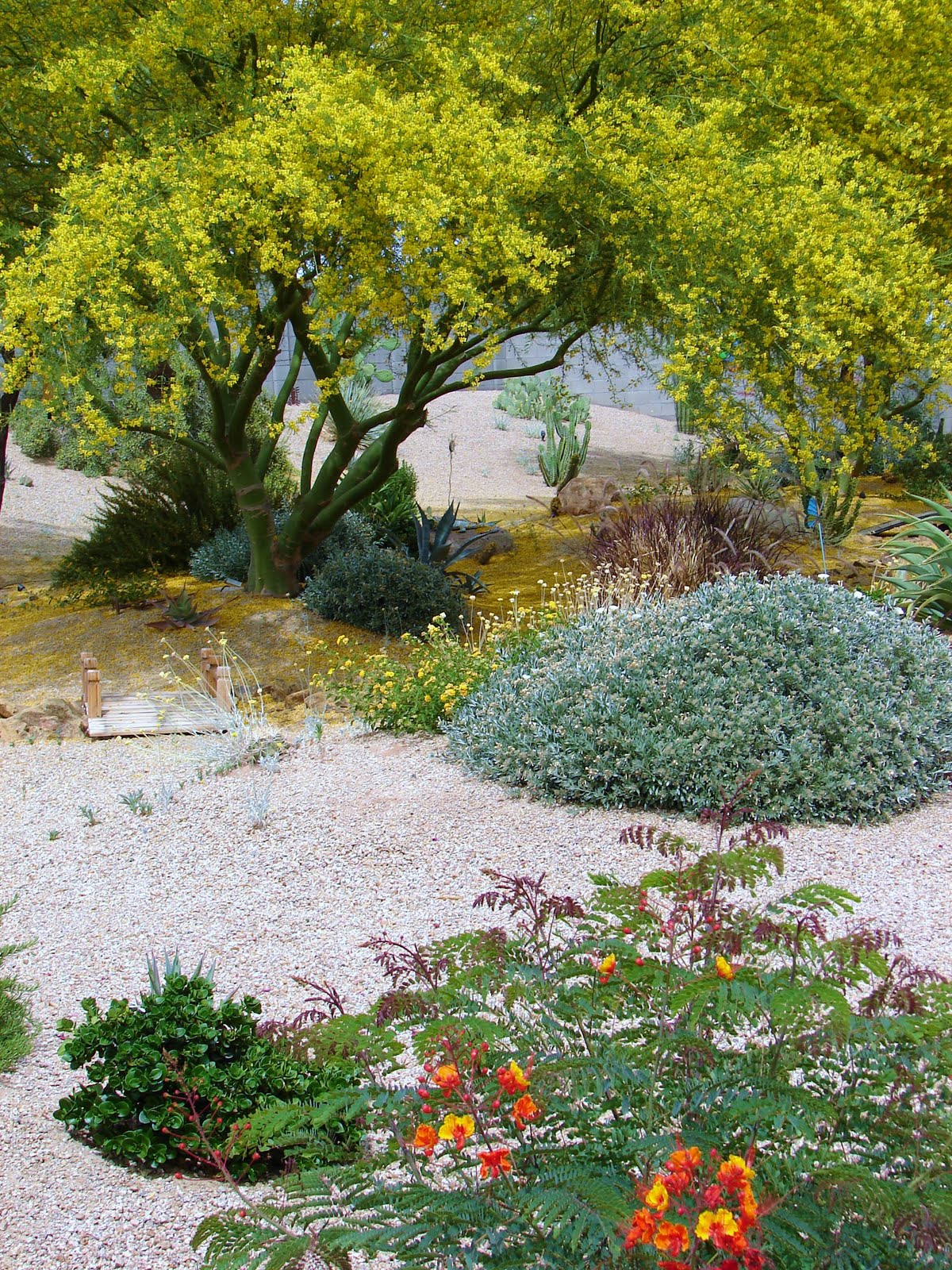
All my Palo Verde trees are just starting to bloom and the strong wind gusts are blowing the flowers everywhere. Usually, I have a golden carpet an inch thick around and under the trees all spring. This year, they are going to be all over my yard, and I'll have to have the blow-and-go guys over a couple of times to clean it up. If we get any rain when there is a lot of debris on the ground, it forms a hard crust that has to be raked up. I learned this lesson the hard way last year and had to peel away chunks of the crust from around all the cacti and succulents planted under the trees, and then clean up the plants as best as possible with tweezers and kabob skewers.


These coral colored Gasteria acinacifolia flowers remind me of flamingos for some reason. It's more than the color. Do you see any resemblance, or am I dreaming again?


Rosa 'Red Intrepid'
has just started to bloom. It has suffered wind damage like all my other roses have this past week. The new leaves look like they've been through a threshing machine, and the flowers all have sun and wind burn. I have a lot of tattered roses on each bush. It is such a disappointment to see them all beat up like this, as this is our peak rose time here in the Phoenix area.


The flower stalk on this Coral Aloe is now a month old with no sign of wilt or drying. I really should have several more of this Aloe species, all planted in the same location. I think a display of multiple flower stalks like this would be quite striking. Maybe in the fall....


Rosa 'Gold Glow'
is in a more protected area and has suffered less wind and sun damage. This flower opened Sunday after the strongest gusts passed through.


My one Spanish Lavender (Lavandula stoechas) shrub is in full bloom right now. Unfortunately, it doesn't look this good any other time of year. Most folks use Spanish Lavender in groupings or as border plants, but I like them one at a time. In this photo you can also see several Bush Morning Glories in bloom in the background. They are now a bit past their prime.


Bees are buzzing everywhere in my garden, enjoying the blooming Creosote bushes, Spanish Lavender and Palo Verde blossoms. So many bees are a welcome sight, and provide hope that the bee population is increasing after its decimation these past few years. I also have more birds this year, especially hummingbirds. However, one bird species that I wish would show up now and then is Gambel's Quail. I've never had one visit my garden, and I miss seeing them, usually with their babies, walking in a line behind the mother, with their little topknots bobbing. They were a common sight at my previous residence, and I blame the roaming neighbor cat for their non-appearance at my current residence.

Tuesday, March 3, 2009

Some Spring Color

Some of my older Parry's Penstemon plants are in full bloom now. The youngest ones are just beginning to open and I have quite a crop. The yellow flowers are Brittle Bush.


This Parodia Horstii has a straw flower-like bloom. This cactus can be solitary, or clustering, as this one is doing. The new stem is barely visible in this photo.


Valentine Emu is still going strong, so I won't be shearing it anytime soon. It needs it badly, as it is so heavy it is leaning now. These shrubs, unlike other shrubs in my garden, can take a good shearing every spring.


An out of focus Thelocactus bicolor, commonly known as Glory of Texas, is in full bloom now. In the background is Desert Marigold. Both of the cacti I've shown here are blooming early. Very few of my other cactus specimens are showing any sign of budding. By April, I should have quite a few!

Saturday, February 28, 2009

The Trouble With Cassia


Feathery Cassia (Senna artemisioides) is a wonderful desert shrub that looks good until it gets older and the branches become woody. It has a very strong honey-like fragrance when it blooms in the spring. Some varieties have a licorice scent, like the one I have in my front landscape. The flowers last for about six weeks.Toward March though, the shrub forms numerous seed pods. All of these seed pods need to be remove by hand, or with a shearing after the flowers are gone. I choose to hand pick the seed pods and that is a lot of work. Just about the time you think you're done, more have grown, so it's back to hand picking until about May 1.


These are new seed pods that formed just in the past week. They are very fast growing, and if left on the shrub, they eventually dry and split open. The seeds easily sprout, so unless they are eliminated before splitting, I'll be pulling up baby Cassia for months! At this stage they are attractive, but not enough so that I keep them on the shrub.


`````````````````````````````````````

They say the definition of crazy is when someone does the same thing over and over with the same bad result. I'm beginning to think I fit that definition. I continue to purchase various appliances, cameras, computers and other electronic items from one national big box electronic store with the same results. Things always go wrong with the items, and I have to have their repair squad come to fix whatever it is. They never seem to get it right the first time, so I get on a merry-go-round of returns, pickups, new repair visits, etc. In one case with my home theater system, they have been coming out for over nine months. Each repair guy blames it on a different component, and then that component needs to be sent for repairs, or else another specialist needs to come for repairs for other components. Next week, I'll see if they have finally solved the problem when they install a part on the TV. They ordered the part two visits ago, but when the guy came to install it he discovered they had ordered the wrong part. He will come with the right part (I hope) and he really thinks that will finally solve the problem.


Interestingly, these repair guys always blamed my cable company, but that was never the problem. In the last of five repair visits with the cable repair people, the cable repair guy proved the problem. I had asked the store repair people to hook up another TV to test to make sure it wasn't the TV, but they all said it couldn't be the TV, it was either the reciever or the cable signal. The cable guy finally hooked up another TV as I asked, and it is definitely the TV.


My whole point in rambling on about my problems is that my two month old computer had to be repaired as the hard drive was defective, and after that was replaced, I had to take it back twice before the thing was right. Hence, no blog posts for over a week! It's a good thing they don't sell cactus as I would have a yard full of dead plants with their record! I think I've learned my lesson, finally.

Monday, February 16, 2009

Same old, Same old.


Other than a few Desert Marigolds, some shrubs and a Penstemon here and there, not a lot is blooming in my garden. In looking back on last year's posts, I had far more going on than I do this year. I think it's the difference in precipitation and temperature.

Bryophyllum 'Crenatodaigremontianum'

Eleven weeks after the stalks of this viviparous plant reached their maximum height and formed buds, the flowers finally opened. The little flowers and the stalks are a nice color, and no telling how long they will last considering how long they took to bloom! The leaves of this plant really look awful right now; yellow, flabby and browned at the margins. After doing some research, I learned that unlike most other succulents, this plant should not be allowed to dry out in winter as it will cause wilting of the leaves. I don't know if I can turn it around at this point. Even if it dies, there are hundreds of babies growing in the pot to replace it.

Larrea tridentata


This Creosote Bush has now achieved the look that I like. Of the four bushes I have on my property, this one receives the least water, so it looks far more natural than than the others, which are larger and more lush. Their roots are able to reach out and get water from nearby plants. I did not adjust the size of this photo so that you can click and see the dark rings on the gray branches. That's why I like it with fewer leaves.