Wednesday, February 20, 2013

Time To Say Goodbye


My husband has not been well for quite some time, and is now unable to do much at all. He needs a lot of care, so needless to say, trying to maintain our large property has become impossible for me. We have purchased a smaller home on a tiny lot. It has a great mountain view, and is in a very quiet gated community. It will be quite a change, but a necessary one.

I have a lot of good memories of establishing my garden and blogging about each of my plants and of the various blog friends I made along the way, but I must close that chapter of my life and move on. My husband needs a lot of care and that comes first.

Perhaps someday I can get back to gardening, albeit on a much smaller scale. I am taking about 15 potted cacti and succulents along to the new place, which is probably 10 too many for the size of the lot. The rest of my container cactus will go to various friends and our landscaper and all my yard art will either stay with the property or go to friends. What I will miss the most are all my wind chimes. I'll be lucky to be able to have one if the very close neighbors don't complain!

Even though I have not posted for quite some time, I still get questions from readers who happened to visit my blog while looking for information on a particular plant, and I've answered them all the best I can, and I will continue to do that as time permits. I do hope that I can occasionally visit my favorite blogs.

So long...

May the longtime sun shine upon you,
 all love surround you,
and the pure, pure light within you,
 guide your way on.
 

Monday, October 1, 2012

The Big Stink

Stapelia hirsuta 


It's the time of year when temperatures cool and getting to spend time on the patio is again possible. It's also time for my 'S. hirsuta' to bloom. So far, it's had about eight flowers on it, but this one is the largest one to date. And it stinks! So much for enjoying my patio. The smell attracts flies and other insects that feast on carrion, and they then act as pollinators. As you can see, a fly has burrowed in the flower and is doing what it is supposed to do. I don't move the plant off the patio. I weigh the smell against being able to see the interesting flower, and the flower wins!

Monday, September 3, 2012

A White Agave

Agave angustifolia 


Agave angustifolia is a prolific producer of offshoots, or pups, as this mother plant demonstrates. Usually, the pups are similar in appearance to the mother plant with some minor variations, so when this pup came up last fall, I was quite surprised, and just assumed it was defective and would die quickly. However, it continued to grow but at a slower rate than expected. Mutants are not that uncommon, but seeing a mostly white pup is rare. It's sort of a white 'Black Sheep'. A standard Agave angustifolia 'marginata' has a narrow white stripe on each side of the leaves as you can see in the mother plant. The width of the stripe can vary from plant to plant. In the pup shown above, the leaves are mostly white with just a strip of green in the center.

In a few weeks I'll be separating this pup and will transplant into a large pot. It will be interesting to see the pups it will eventually produce.  

Saturday, July 14, 2012

Best of a Bad Lot

Gymnocalycium schickendantzii
Giant Chin


This Giant Chin bloomed today--must like the hot and humid weather of monsoon.  This summer has been pretty nonproductive in my garden, a few blooms here and there, but none nice enough to post. I must need to fertilize more. These flowers are the nicest of the season so far.

Tuesday, May 1, 2012

May Miscellaneous


Last fall I transplanted a Crown of Thorns (Euphorbia Milii) from a pot into my yard. It seems to be doing well, but the intense heat has not yet started and it is recommended that in the Phoenix area they get light shade. This plant will get some afternoon shade, but it may not be enough. We'll see.


 This Agave angustifolia provided an interesting view from my dining room windows, but soon my view will change. Once the stalk matures, the Agave will begin to die. Not a quick process--I'd say it will be ready to be discarded by mid-July. I don't envy the landscapers who will be attacking this chore.


This Desert Willow tree (Chilopsis linearis) isn't mine--it belongs to a neighbor who planted it very close to my back block wall. Although it provides a nice show of flowers this time of year and again in the fall, it might as well be my tree because of all the debris it drops in my back yard.


Several of my Prickly Pear cacti are now in bloom. I have seven varieties, and this is the only one that I can't name. I got a pad of it at a Cactus and Succulent Society meeting years ago, and it is quite large now. I've never been able to identify it as there are dozens of species and varieties. 


It was a good spring for my roses--large blooms but little fragrance. This was taken late April. Although they are still producing buds, the heat is just too much and they dry and fry quickly. It was pretty while it lasted. 

Monday, April 16, 2012

Resting Place

Pachycereus marginatus 


We had a gorgeous day Sunday, low 70s, breezy, with clear blue skies. It was quite a treat after a long period of hazy, cloudy days. I snapped this photo from inside the house as I knew that dove would take off if I opened the door! However, the reason for the photo was not to show the dove but to show the first time buds on my Mexican Fencepost cactus. When they finally bloom, the flowers will be bright red. This cactus now has five stems, and this one, the tallest, has grown to over nine feet! It grows about two feet a year, and can get up to about 20 feet tall. The cactus is frost sensitive, so the tips have to be protected to prevent damage. Luckily we had no frost this past winter. I guess I'll have to get out the ladder if frost is expected next winter--but if this cactus grows taller than my ladder, it's going to be on its own with no help from me!

Tuesday, February 14, 2012

Fading Images


Several years ago, my daughter-in-law made this prayer flag for my birthday after I mentioned learning about Tibetan prayer flags on an art and photography blog. My daughter-in-law chose the symbols to use and hand stenciled the designs and lettered them in Sanskrit. She then hand colored each panel. She did not follow the traditional prayer flag format for my flag. Her work was so exquisite I did not want to expose the flag to the elements, so I hung it in my breakfast area. After a few years, I decided to place the flag in my garden, as it was meant to be. According to the Tibetan belief, as the images fade from exposure to the elements, the prayers of the flag are said to become a permanent part of the universe, just as life moves on and is replaced by new life. Tibetans renew their hopes for the world by continually mounting new flags alongside the old. This act symbolizes a welcoming of life's changes and an acknowledgment that all beings are part of a greater ongoing cycle. I'm glad I placed the flag outside where I can see it from my windows or when I'm walking in the garden. I think of the sentiment connected to prayer flag every time I see it moving in the breeze.


My Lilac Vine (Hardenbergia violacea) has grown so much that it now covers a good portion of the block wall on one side of my house. It has also grown over the wall, and can be seen from the roadway. That is how I knew it had bloomed. As I was rounding the corner to my house, I saw that the vine had bloomed overnight, so I went to my backyard and took a close look. Because the wall has a southern exposure, the sun shines in such a way that the blooms are not obvious unless you step into the shade of the house to shield your eyes from the sun. Had I not noticed the blooms from the roadway, I might have missed it at its peak blooming as it is at least three weeks earlier than previous years.   


January is rose pruning month in the Phoenix area, but as usual, I was late and didn't get around to it until the first week of  February. Actually, any time between early January and early February will work, but I've had more April blooms when I do it early. By the time I got around to it, all the rose bushes had gone dormant, except my Red Intrepid. This rose bush lives up to its name--it produces blooms almost all year long--although in the extreme heat of summer, the blooms are deformed and sparse. It is also the one rose that I have that produces no scent. The pruning produced this nice bouquet!

Saturday, December 31, 2011

Happy New Year 2012


NEW YEAR


At the sound of the tolling midnight bell
a brand new year will begin.

Let’s raise our hopes in a confident toast,
to the promise it ushers in.

May your battles be few, your pleasure many,
your wishes and dreams fulfilled.

May your confidence stand in the face of loss
and give you the strength to rebuild.

May peace of heart fill all your days
may serenity grace your soul.

May tranquil moments bless your life
and keep your spirit whole.

~ Author Unknown ~


Tuesday, November 8, 2011

November Cactus Jack


Bougainvillea 'Barbara Karst'


I finally planted a small tree aloe that has been languishing in a pot for the past two years. I hope it lasts. In this region, it must be protected from frost, so it is a leap of faith to put it in the ground. I'll have to keep an eye on the weather forecast and cover it when necessary. I keep telling myself I won't add more garden chores with my choices, but here we go again!


Right across the road from my house, cabbage harvesting is in full force. they strip and pack the cabbage in boxes right there in the fields. I'm surrounded with fields of organic vegetables grown specifically for the gourmet restaurants in the Phoenix area. Currently there's cabbage, loose leaf lettuce and kale in nearby fields. So close, yet so far away! These fields are guarded 24 hours a day. Occasionally, I see some brazen people stop, run to the fields, steal a few cabbages and beat it back to their vehicles before the guard can reach them in his truck. The guard won't chase them once they are back on the public road. Vegetables aren't as popular with the thieves--they prefer melons--and in season the growers have more than one guard watching over the fields.

Sunday, October 16, 2011

Aralia Houseplants

Polyscias balfouriana (Aralia Balfour)


Back in the 1970s, I joined the houseplant craze and loaded my house with coleus, Swedish and many other ivy plants, dracena, pathos, creeping charlie, wandering Jew, spider plants, dracena, and even Boston and maidenhair ferns hanging from a shower rod in the bathroom, put there to help provide the necessary humidity in our dry Arizona climate. And, of course, my nicer specimen plants hung in macrame hangers of various sizes and weaves. Some of the smaller plants were housed in owl shaped pots--another fad that was going on at the time. I had about 25 or 30 plants, a meager collection compared to some others in my circle of friends and acquaintances. Plant acquisition in the 1970s was that era's version of keeping up with the Jones'. Some had upwards of 200 plants. Their homes looked liked mini-jungles. Even restaurants and shops had houseplants hanging from the ceilings and in rows of planters. Far out!

Macrame plant hangers weren't cheap back in the day, so I bought a few rolls of jute and some chunky ceramic beads and tried to make my own. I just couldn't get the weaving and knotting down, so my teen aged daughter did it for me and she finished a huge fancy hanger for me in just a few hours. That macrame hanger with its bright orange pot filled with a large trailing pathos became the focal point of our small living room. Groovy.

As with all fads, the houseplant collecting and macrame craze faded, and as my plants died they weren't replaced. Since those days, I've always kept one or two indoor floor plants (usually a dracena palm, money tree and some type of succulent) but in the past few years I've added a few smaller plants, and right now I have 12 total, including these two latest acquisitions.

The first, Aralia Balfour, is my favorite. It is about 24 inches tall and of the two Aralias, it is the easiest to care for and most hardy. Over watering is the biggest threat to this plant, so I'll have to pay special attention until I figure out what it will need in its environment. So, far, it's doing well and even has many new leaves.

 
Polyscias fruticosa (Ming Aralia)


The Ming Aralia is more fussy. It needs more humidity, so I keep the pot in a shallow dish  with an inch of water to bring up the humidity for it. The water does not touch the pot, so the plant won't get waterlogged and develop root rot. I also spray it with water, usually once a day. Ming Aralias are known for leaf drop, so I'm keeping a close eye on this to make sure it's not excessive. As with the Balfour, it is important not to over water. I'm hoping my two new plant additions last as long as my Money Tree and Dracena marginata, both of which are now 11 years old.

Friday, September 30, 2011

Summer's Almost Gone


When the Queen's Wreath blooms, it's fall. I was hoping this was the year this vine would thrive, but it was not to be. The summer was particularly brutal this year, and so many plants struggled for months just to stay alive. It's not a lack of water (even though we've had only 3 inches so far this year) it was the sun's intensity. 

I lost many, probably about 15, perennials this summer, but I think most of them died a natural death rather than succumb to the heat. They were all six to seven years old and had lived their cycle. As my landscape has matured I've replaced fewer and fewer plants, but these latest deaths left bare spots that need filled in. So, I'll be spending some time in a couple of nurseries in the next couple of weeks, trying to make up my mind what the replacements will be. I don't think I'll go beyond the tried and true, I seem to have lost the urge for adventure in the garden.


An early September trimming is all it takes to revitalize the Lantana plants and get them blooming again. By late August, they are quite large and sprawling, with no flowers--dusty and dry looking. For a few weeks after the trimming, they look worse than ever, but look at how symmetrical and full they are just a while later. They will now bloom for months, just like this.


September is Ferocactus cylindraceus flower time, and it looks like I'll have flowers well into October. We had a light rain about three weeks ago--the first in many months, and that prompted this last push. I've collected seed from the fruit for years, and have occasionally started some ferocactus seedlings, but I've never been interested in this aspect of gardening, so I tossed out about a quarter pound of seed recently. I still feel kind of guilty about it for some reason.

Friday, July 15, 2011

It's Come a Long Way...

 Most sources say that a landscape can be considered mature when it is around three years old. I don't agree with that. Six years is probably more accurate, which is now the age of my landscape. At three years, my trees and shrubs were far from the mature sizes listed in garden planning literature. Now, they are about the size expected at maturity. This photo shows what I started with when we moved to this property.


This is what part of my back yard looks like now. Over the years we've lost quite a few trees to the elements, various perennials to age, prickly pear cactus to cochineal scale, other plants to drought, others to rot--just what you would expect over the life of a garden.


 As the landscape matured, I replaced fewer and fewer plants. When everything was new, I needed numerous plants to make it look less barren, but as the landscape matured, there was little need to replace. When I talk about a mature garden, I do exclude cacti and Agave species, which will continue to grow for decades.


What do I wish I would have done six years ago if I could do it over again? Rather than my heavy emphasis on zeriscape with all the Mesquite and Palo Verde trees, I would have planted a 'Wonderful' pomegranate, a few 'Arizona Sweet' orange trees and a couple of 'Desert Gold' or 'Earli Grande' peach trees, a Mission Fig rather than the Brown Turkey Fig I have that has not done all that well. In addition, had I planted fruit trees, I would have put in a separate irrigation valve dedicated to the fruit trees, and there would have been a raised, enclosed vegetable garden with retractable sun shade, and a separate vegetable garden irrigation valve.

But, we don't get do-overs, so as long as we live here, my garden is what it is, and that's the way it's going to stay. I'll just buy my fruit and vegetables at the grocery store.


Sunday, April 24, 2011

April Flowers


 My favorite cactus bloom--Echinopsis 'Flying Saucer'. The flowers last just about 12 hours, so this time of year I have to keep a close eye out in order not to miss them.


Here is a second round of the 'Flying Saucer. Last year, I was not so lucky. There was only one round of blooms.


 Past its prime but still beautiful--Rosa Queen Elizabeth. My roses were extra large this year, but not very fragrant. I changed fertilizers, and I think that must have made a difference.


 'Hello Dolly'

Of my roses, this is the most fragrant this year. There is a controversy as to whether this is truly a 'Hello Dolly', a hybrid by Jack E. Christensen which is described as a yellow hybrid tea. Whatever it is, it's a beautiful rose. If I could find 'Brandy' or 'Brass Band' by Christensen, I'd try them, even though they are not really suited to our zone and would have to be planted in the coolest part of my garden.


'Gold Glow' has been a good rose for me, despite warnings that it is more susceptible to a variety of diseases and pests than other hybrid teas. It has a light fragrance and the flowers last longer than some of my other teas.


I can usually predict when 'Flying Saucer' is getting ready to produce blooms by watching this Argentine Giant, which is visible from my breakfast area windows. Sure enough, both bloomed on the same day and I was ready with my camera!

Sunday, March 6, 2011

This Is It

Lilac Vine


This has been a very disappointing year when it comes to spring flowers. I have thousands of California Poppy, Desert Bluebell and Desert Marigold plants, but as of today, I have one California Poppy and three Desert Bluebell flowers in bloom. There are also a few Desert Marigold flowers, as well as a couple of Parry's Penstemons blooming. It will soon be too late for these plants to put out blooms because our weather is quickly warming up. This is the worst year yet for wildflowers in my garden, but I'll still be left with the job of pulling up all the plants as they begin to dry up. Oh well, I've been spending a couple of hours each day pulling weeds, so what's a few thousand more?

My Lilac Vine is still blooming, but its little flowers are waning, so there won't be much color from now until the Palo Verde trees flower. The Bougainvillea, Orange Jubilee, Yellow Bells, Queen's Wreath and Cape Honeysuckle all suffered extensive damage during the hard freeze, so no color there until May or later.  My roses have really leafed out, but there is not one bud to be found so far. In six weeks the roses will be past their spring flowering prime, so I hope they hurry up!

Monday, January 31, 2011

Promises, Promises

Chuporosa
It's still officially winter, but there are many blooming plants in my landscape, and the promise of more to come. We had a couple of days of below freezing temperatures earlier in the month, so I have lots of dead plant material left unpruned. It is acting as an insulator in case we have more frost. It doesn't look so hot in my garden right now, but with the extra rain we received earlier in the month, spring should bring lots of wildflowers. And weeds!


Cape Honeysuckle

Today I spotted a male Costa's hummingbird (Calypte costae) with its beautiful iridescent purple head and breast and iridescent green back. As it was retrieving nectar from this heavily blooming Cape Honeysuckle, I rushed in to get my camera but when I got back, the bird was gone and didn't return. This is the first time I've seen this particular hummingbird in my garden. I hope more return. Check here for a great photo of the Costa's hummingbird.


Aloe sinkatana


Desert Marigold


Feathery Cassia


Volunteer Nasturtium
I'm really surprised that I have so many volunteer Nasturtium plants showing up in various containers around my garden. Sometimes my husband mixes old potting soil in with the new stuff, and I think this may be how this is happening. I asked him why he always retrieved the potting soil I throw out, and he said it seems like such a waste, so he mixes it with the new soil. After getting odd plants coming in here and there, I think he's now convinced this isn't such a good idea.

Mexican Bird of Paradise


Lilac Vine (Hardenbergia violacea)

This vine is really loaded with little buds, so in a couple of weeks, this plant will have a spectacular display. The vine has grown quite a lot in the past year, and now covers about eight feet of one of my block walls. Wish I would have planted several more. It was a good choice! It is an Australian native and is well suited to our area, but not yet in common use here. It seems impervious to frost and extreme heat. It is a twining vine so it needs a trellis for support. I use vine wires on the block wall and that works well. Since it can be easily propagated with softwood cuttings this time of year, I may try that to get more of these to cover another section of block wall. The vine looks great year round, even when not in bloom.


   Valentine Emu is loading up for its February show. Sometimes there are so many flowers that the plant can't stay upright. This is one plant that improves with pruning and shaping after the blooming period. This is another Australian native.


Yellow Emu

Friday, December 31, 2010

Happy New Year 2011


A hard freeze is predicted again for New Year's Eve, so all my columnar cacti are dressed for the occasion. The Styrofoam cups protect the growing tips. I've covered many of my potted cacti and a potted Meyer Lemon, but all the rest of my plants are on their own. I'm sure the Bougainvillea will be the first to go, followed by the Queen's Wreath, but come February, they should start coming back.


Ring out the old, ring in the new! This Agave desmettiana is on its way out now that it has produced a stalk. Unfortunately there are no pups to replace it. It hasn't produced any for the past two years. I'm not sure what the freeze will do to the stalk and its budding inflorescence.


This is the only rose currently in bloom in my garden. It's a Red Intrepid, and it lives up to its name. This one rose bush produces an abundance of roses nearly year-round. However, it has very little fragrance. This past year has been a disappointment in the rose department. I haven't had any roses on the other bushes since October, and what few there were weren't much to look at. In a couple of weeks I'll be pruning and remulching, and then in February start with the fertilizer.

We've finished the year with 12.69 inches of rain, compared with last year's 4.28. The average is around 7.5 to 8 inches. The weed crop should be fantastic this spring!

Thursday, December 16, 2010

Tricky Transformation


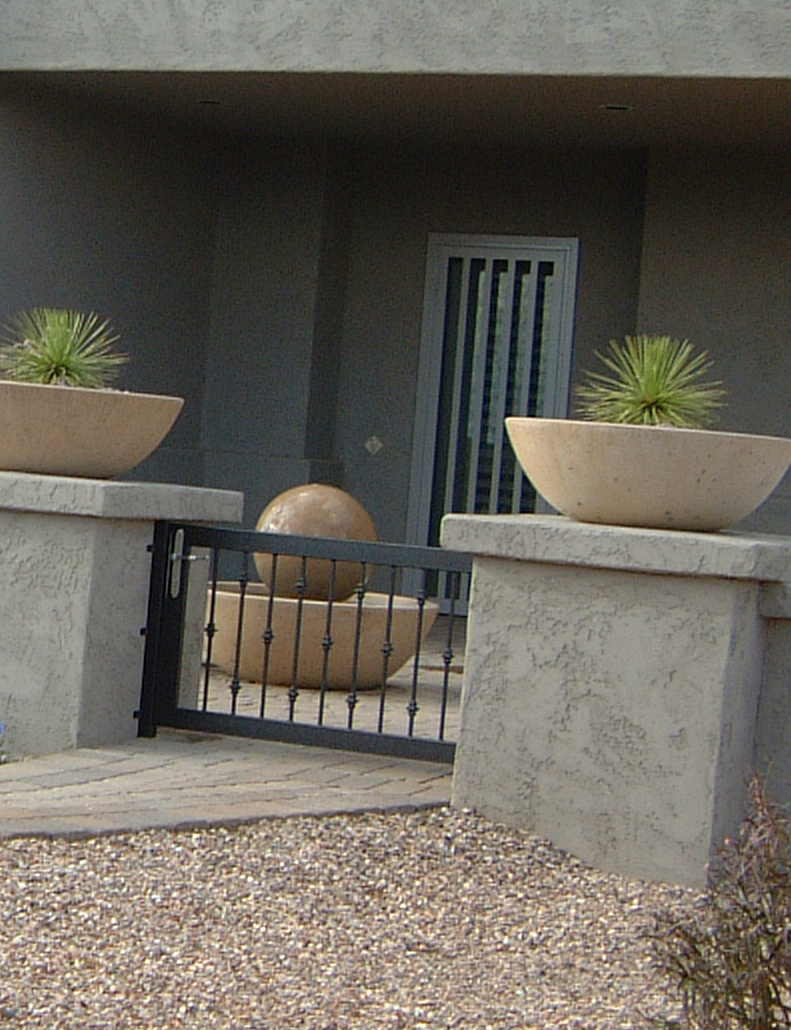
The sound of trickling water here in the desert makes it seem cooler somehow, so a fountain in my front courtyard was a top priority when I designed my landscape back in 2005. I didn't want one of the typical Mediterranean styles that are the most common around here because my house is more Southwest Contemporary in style. So, I chose a wok and ball style fountain that basically just delivered water up the center of the ball and bubbled up just enough to wet the ball. The photo, taken soon after installation, is not the best, but you can get the general idea.


All was well for several years, but eventually the pump seemed to lose its steam, so we sought to replace it. What a farce that turned out to be. In order to replace the pump, the large concrete ball had to come off its pedestal, the pump replaced and the electrical cord rethreaded through a special opening. The first repair company was unable to move the 800 pound ball, even with four helpers. The second repair company brought a small army and removed the ball, but they were then unable to figure out how to remove the pump's electrical cord. The third company brought a new pump, put it in place, but then couldn't figure out how to rethread the electrical connection. They said they would be back as soon as they figured it out, but they never returned. I guess they never did figure out how to do it. So, the whole thing sat in four pieces for several months while we tried to find a company that could handle the job properly. By then, we had put so much money into the various attempts at repair plus the cost of the new pump, that hiring yet another company seemed kind of stupid, so we just decided we didn't need a fountain. I had our landscape maintenance crew roll the 800 pound concrete ball to our back yard, and we converted the fountain into a planter with a kinetic wind sculpture in the center.


The ball now sits in my backyard, as yard art. It also makes a seat of sorts, except in summer! If I ever get enough ambition, I may Mosaic the whole thing.


The whole ordeal of changing over the fountain was so frustrating that I procrastinated in purchaing potting soil and plants. Today I finally got around to getting some seasonal bedding plants and soon I'll have some flowers, fragrance and movement in my courtyard. However, I've just added to my garden chores because I have one more thing to hand water! Come summer, I'll probably fill the thing with rocks and just let the wind do the work.